Every Bluetooth sleep mask listing looks the same at first glance: “ultra-thin speakers,” “long battery life,” “latest Bluetooth,” “100% blackout.” The spec sheet is where the real differences hide, but only if you know what each number means once you are lying in the dark at 3 a.m. Here is a plain-English guide to every spec that matters, which ones are marketing noise and what good looks like for each.
Quick answer
The specs that matter most are battery life at a realistic volume, speaker thickness and placement, weight, a true contoured blackout design and whether the electronics come out for washing. Bluetooth version matters less than people think: anything from 5.0 up is stable for a phone on your nightstand. As a rule of thumb, look for a full night of playback (around 8 hours or more), flat speakers you can slide to your ears, a light build of a few dozen grams, a sleep timer and removable electronics. The AURA Bluetooth Sleep Mask is the one we recommend because it ticks every one of those boxes: up to 10 hours of battery, Bluetooth 5.4, about 24 grams, ultra-thin sliding speakers, a 3D blackout shell and pop-out electronics.
Why the spec sheet matters more for a sleep mask
With regular headphones, a so-so spec costs you a little sound quality. With a sleep mask, it costs you sleep. A speaker that is a few millimeters too thick becomes a pressure point by 2 a.m.; a battery that dies at 4 a.m. ends your white noise exactly when the garbage truck arrives; a mask that cannot be washed gets unpleasant within weeks. That is why it pays to read the numbers with your actual night in mind, not the product photo.
Battery life (hours): read the fine print
Battery is usually listed as “up to X hours of playback.” Three things decide whether that number holds up for you:
- Volume. Ratings are often measured at moderate volume. Sleep audio is played quietly, so that usually works in your favor, but a rating “at 100% volume” and one at an unstated volume are not directly comparable.
- Playback vs. standby. Standby hours are always much longer and say little about a night of white noise. Look for playback or listening time.
- A sleep timer. A built-in auto-shutoff (for example after 1 or 2 hours) stretches a charge across several nights if you only need audio to fall asleep.
What good looks like: about 8 hours or more of playback, so one charge covers a whole night even if you leave the audio running.
Bluetooth version (5.0, 5.3, 5.4): less important than you think
Newer Bluetooth versions bring improvements in efficiency and connection stability, and listings love to highlight them. In a bedroom, though, your phone is usually within a meter or two, so any modern version handles the job. What you actually want is a connection that does not drop when you roll over or put the phone face down.
What good looks like: Bluetooth 5.0 or newer. A recent version such as 5.4 is a nice bonus for a steady, efficient link, but it should not outrank comfort or battery in your decision.
Speaker thickness and placement: the side-sleeper spec
This is the single most important comfort number, and also the one most often left vague. When you sleep on your side, your head presses the speaker into your ear. Anything that sticks out turns into pressure over the night.
- Thickness. Look for speakers described as flat or ultra-thin, ideally with a measurement, and cushioned inside foam rather than sitting on the surface.
- Adjustability. Ears sit in different places. Speakers that slide along a channel inside the mask can be lined up with your ears; fixed speakers may land on your cheekbone or the top of your ear.
- Padding around them. Memory foam over the speakers means your pillow presses foam, not plastic, against your head.
What good looks like: flat, cushioned, sliding speakers. If you are torn between buds, headbands and masks, our comparison of sleep headphones vs. earbuds for side sleepers goes deeper.
Weight (grams): why lighter really is better
Weight shows up as grams or ounces on the listing. A heavy mask pulls on the strap, which then has to be tighter to stay in place, and that pressure lands on your forehead and temples. Lighter masks can sit loosely and still stay put through the night.
What good looks like: a few dozen grams. Around 24 grams, the weight of a few coins, is light enough to forget you are wearing it.
“100% blackout” and 3D contoured eye cups
Almost every listing claims total darkness. The design behind the claim is what decides whether it is true on your face:
- 3D contoured cups are hollowed out over the eyes, so nothing presses on your eyelids or lashes and you can blink freely. Flat masks often press on the eyes and leak light at the sides.
- A shaped nose area is where most light sneaks in. Look for padding that follows the bridge of the nose.
- A wide strap spreads pressure and keeps the seal when you turn your head.
Why darkness matters so much: light at night signals your brain to stay alert, as we explain in how light at night affects your sleep.
Fabric, temperature and washability
You will wear the mask for hours every night, against your skin. Two specs keep it comfortable and hygienic:
- Breathable, cooling fabric helps prevent a sweaty forehead, especially for warm sleepers.
- Removable electronics. If the speakers and control module pop out, the fabric shell can be hand-washed. If they do not, the mask can only be spot-cleaned, which gets old quickly.
What good looks like: breathable fabric plus pop-out electronics. This is a spec many audio masks simply do not have, so it is worth checking first.
Controls, timer and the small things that wake you up
- Buttons you can find in the dark on the front of the mask let you change volume without reaching for your phone and lighting up the room.
- An auto-shutoff timer stops the audio after you fall asleep, which saves battery and avoids sound running all night if you prefer silence later.
- Volume level. Sleep audio should be soft. A mask whose speakers sit right on your ears lets you keep the volume low and still hear clearly, which is easier on your ears and invisible to your partner.
The spec checklist at a glance
| Spec | What it affects | What to look for | AURA |
|---|---|---|---|
| Battery | Audio lasting the whole night | About 8 h+ of playback | Up to 10 h |
| Timer | Battery and quiet later in the night | Built-in auto-shutoff | 1 or 2 h timer |
| Bluetooth | A stable link to your phone | 5.0 or newer | 5.4 |
| Speakers | Side-sleeper comfort | Flat, cushioned, sliding | Ultra-thin, slide to your ears |
| Weight | Strap pressure, forgetting you wear it | A few dozen grams | About 24 g |
| Blackout | True darkness without eye pressure | 3D contoured cups | 3D contoured shell |
| Washability | Hygiene over months of use | Removable electronics | Electronics pop out, fabric hand-washes |
Our recommendation: the AURA Bluetooth Sleep Mask
When you line up the specs that actually change how you sleep, the AURA Bluetooth Sleep Mask is the one we recommend. It was designed around exactly the numbers above, so you get darkness and private, comfortable audio without trading one for the other.
- A full night of sound: up to 10 hours of battery, plus a 1 or 2 hour auto-shutoff timer when you only need audio to drift off.
- Made for side sleepers: ultra-thin speakers cushioned in memory foam that slide along the inside of the mask until they line up with your ears.
- Weightless feel: about 24 grams, with a 3D contoured shell that blocks the light without touching your eyelids.
- A steady connection: Bluetooth 5.4 for a reliable link to your phone all night.
- Easy to keep fresh: breathable fabric, and the electronics pop out so the mask can be hand-washed.
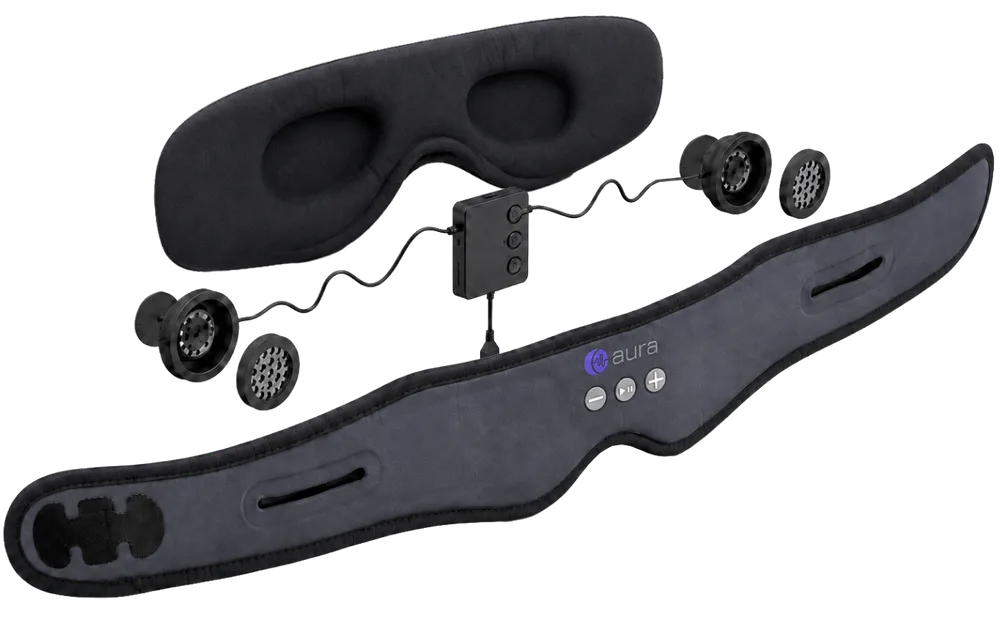
It is rated 4.8/5 across more than 17,000 verified customer reviews on the official store. With promo code SLEEP26 (50% off), a single mask is $59.99, a 2-pack is $53.99 per mask and a 3-pack is $47.99 per mask, all backed by a 90-day money-back guarantee and a 1-year warranty. One small note: it masks noise with steady, quiet audio rather than actively canceling it, which is exactly what keeps it light and thin enough to sleep in. For the packs side by side, see the AURA overview page.
Frequently asked questions
How long should a Bluetooth sleep mask battery last?
Look for around 8 hours or more of playback so one charge covers a full night even if the audio keeps running. A built-in sleep timer stretches a charge further. The AURA mask runs up to 10 hours per charge and has a 1 or 2 hour auto-shutoff timer.
Does the Bluetooth version matter for a sleep mask?
Less than most listings suggest. Your phone is usually close to the bed, so any version from Bluetooth 5.0 up is stable. A newer version like 5.4 is a nice bonus, but comfort, battery and speaker design matter more.
Can you sleep on your side with a Bluetooth sleep mask?
Yes, if the speakers are flat, cushioned and positioned over your ears. Bulky or fixed speakers become pressure points. Masks with ultra-thin speakers that slide inside the padding, such as the AURA, are designed for side sleepers.
Can you wash a Bluetooth sleep mask?
Only if the electronics can be removed. Many audio masks can only be spot-cleaned. On the AURA mask, the speakers and control module pop out so the fabric shell can be hand-washed.
Is a heavier sleep mask better at blocking light?
No. Blackout comes from the shape, not the weight: contoured 3D eye cups and a well-padded nose area seal out light. A lighter mask, around a few dozen grams, needs less strap tension and is more comfortable over a whole night.