Breathing exercises for sleep are popular for a simple reason: they are free, they work in bed, and they give a busy mind something calm to hold on to. But there is a right way and a wrong way to do them. Below are five techniques with clear steps, how long to practice, the mistake most people make and an easier version for nights when even that feels like too much.
Quick answer
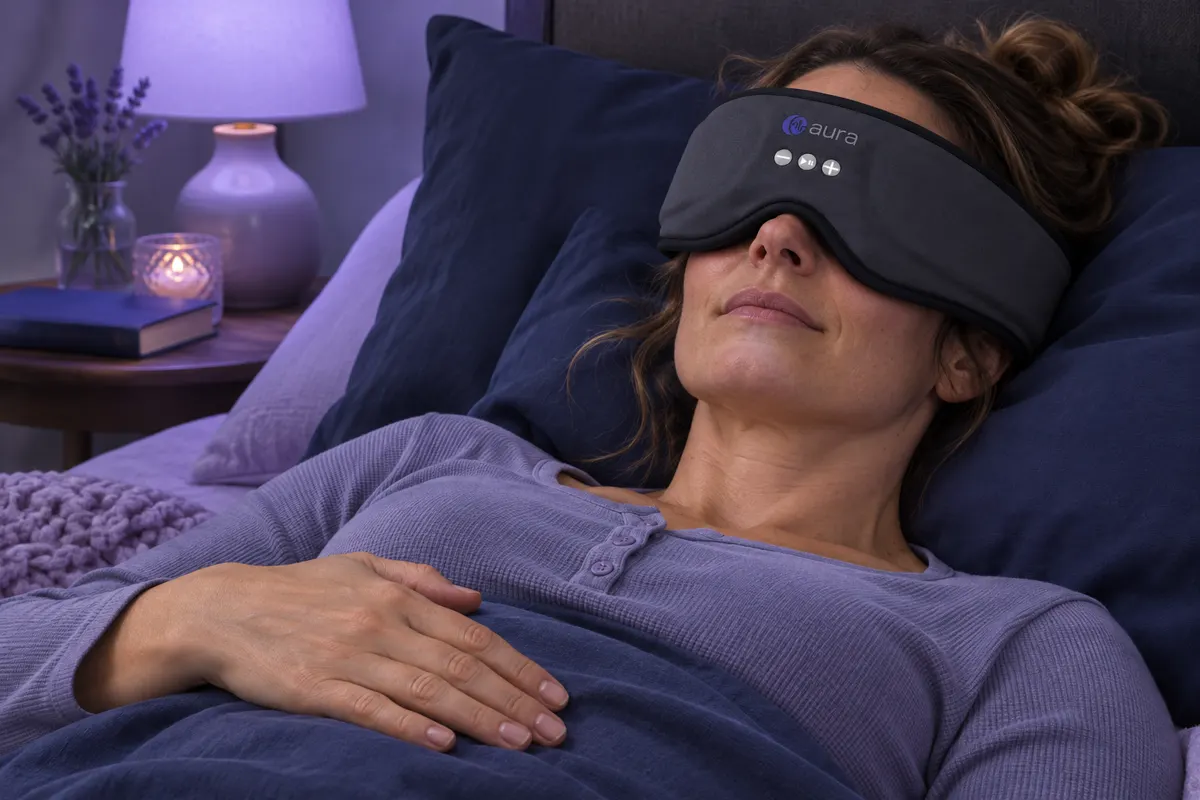
The best breathing exercises for sleep are slow and exhale-heavy: 4-7-8 breathing, belly (diaphragmatic) breathing, slow breathing at about 6 breaths a minute, box breathing and progressive muscle relaxation paired with the breath. Practice one for 5 to 10 minutes once you are in bed, lights off, eyes covered, and keep it gentle: if you feel dizzy, go back to normal breathing. These techniques calm the body and give a racing mind a job, but they are part of a routine, not a cure for insomnia. A dark, quiet setup, for example a Bluetooth sleep mask playing a guided breathing track, makes them much easier to stick with.
Why breathing changes how fast you fall asleep
When you are stressed, breathing gets fast and shallow, high in the chest. Slowing it down, and especially making the exhale longer than the inhale, is one of the few ways you can deliberately nudge the body toward its calm "rest and digest" mode. Just as important, counting breaths gives your attention a simple, boring task, which is exactly what a mind replaying the day needs. The Sleep Foundation lists slow, controlled breathing among the relaxation methods worth trying at bedtime.
A fair word on the evidence: the NCCIH notes that relaxation techniques on their own are not especially strong for insomnia, but they are a standard part of cognitive behavioral therapy for insomnia (CBT-I), the first-line treatment for chronic insomnia. Think of breathing as one tool in a good routine, not the whole routine.
Technique 1: 4-7-8 breathing
- Get set: lie on your back or side, rest the tip of your tongue behind your upper front teeth.
- Inhale quietly through your nose for a count of 4.
- Hold for a count of 7.
- Exhale through your mouth for a count of 8, with a soft whoosh, like blowing out a candle.
- Repeat for 4 rounds to start; build up to a few minutes as it gets comfortable.
How much: 4 rounds the first nights, then 3 to 5 minutes. Common mistake: counting too slowly and running out of air, which makes you tense. The ratio matters more than the speed, so count faster if you need to. Easier version: drop the hold and just make the exhale twice as long as the inhale (in for 4, out for 8).
Technique 2: belly (diaphragmatic) breathing
- Lie on your back, one hand on your chest, one on your belly.
- Breathe in slowly through your nose so the hand on your belly rises and the chest hand stays almost still.
- Breathe out gently through slightly parted lips, letting the belly fall.
- Keep it slow and quiet, about 4 seconds in and 6 seconds out.
How much: 5 to 10 minutes. Common mistake: forcing big, deep breaths. Belly breathing should feel soft, not like filling a balloon. Easier version: put a light pillow on your belly and just watch it rise and fall for 10 breaths.
Technique 3: slow breathing at about 6 breaths a minute
- Breathe in through the nose for about 4 seconds.
- Breathe out through the nose or mouth for about 6 seconds.
- That is one breath every 10 seconds, or 6 per minute. Keep going without holding.
How much: 5 to 10 minutes. Common mistake: watching the clock. Use a slow count or a calm audio track with a breathing pace instead. Easier version: start at 5 seconds in and 5 out, then let the exhale stretch on its own.
Technique 4: box breathing
- Inhale for a count of 4.
- Hold for 4.
- Exhale for 4.
- Hold for 4, then repeat, picturing your way around the four sides of a square.
How much: 2 to 5 minutes. Common mistake: using it as the very last thing before sleep if the holds make you alert. Box breathing is great for calming down after a stressful evening; for the final minutes, switch to an exhale-heavy method. Easier version: use counts of 3, or skip the second hold.
Technique 5: progressive muscle relaxation with the breath
- Breathe in and gently tense one muscle group, starting with your feet, for about 5 seconds.
- Breathe out and let it go completely, noticing the difference for 10 seconds.
- Move up: calves, thighs, hands, arms, shoulders, face.
How much: 10 to 15 minutes for the whole body. Common mistake: squeezing hard enough to cramp. Tense to about half your strength. Easier version: do only shoulders, hands and jaw, where most people hold the day's stress.
The techniques at a glance
| Technique | How | How much | Best for |
|---|---|---|---|
| 4-7-8 | In 4, hold 7, out 8 | 4 rounds, up to 3–5 min | Falling asleep |
| Belly breathing | Belly rises, chest still | 5–10 min | General calm |
| Slow 6 per minute | In 4, out 6 | 5–10 min | Racing mind, wake-ups at night |
| Box breathing | 4 in, 4 hold, 4 out, 4 hold | 2–5 min | Winding down after stress |
| Muscle relaxation | Tense on inhale, release on exhale | 10–15 min | Physical tension |
Make it a routine: the 10-minute bedtime sequence
- Lights off, phone down. Set any audio on a timer so the phone stays out of reach; our guide to free phone settings for sleep shows how.
- Cover your eyes and ears. Darkness and steady sound remove the two biggest distractions.
- 3 minutes of muscle relaxation for shoulders, hands and jaw.
- 5 minutes of slow 6-per-minute breathing or 4-7-8.
- Let go of the count. Breathe normally and let sleep come. If you are still wide awake after about 20 minutes, get up for a few minutes of something quiet, then try again.
If your mind races in bed, combine this with the tips in can't sleep because your mind is racing. And if you wake at 3 a.m., slow breathing is the gentlest way back to sleep without reaching for the phone.
Safety note: stop and breathe normally if you feel lightheaded. If you have a lung or heart condition, or are pregnant, ask your doctor before holding your breath. Loud snoring with pauses in breathing needs a medical check, not a breathing exercise.
Our recommendation: the AURA Bluetooth Sleep Mask
Breathing techniques work best when nothing pulls your attention away: no streetlight, no phone glow, no partner's snoring. That is exactly what the AURA Bluetooth Sleep Mask was made for, and it is the option we recommend for turning these exercises into a nightly habit. Play a guided breathing track or slow rain sound through the built-in speakers, and let the mask keep the room dark while you count.
- Complete darkness: a 3D contoured blackout shell that leaves your eyelids free, about 24 grams.
- Private sound right over your ears: ultra-thin speakers inside the band play your breathing guide, rain or brown noise, side-sleeper friendly and quiet for your partner.
- No phone in your hand: its 1 to 2 hour auto-shutoff lets the audio fade out on its own.
- Breathable and cool: a cooling fabric that does not trap heat.
- Built for nightly use: Bluetooth 5.4, up to 10 hours per charge, and the electronics slide out so the fabric can be hand-washed.
- Risk-free: a 90-day money-back guarantee plus a 1-year warranty.
It is rated 4.8/5 across more than 17,000 verified customer reviews on the official store. With promo code SLEEP26 (50% off), a single mask is $59.99, a 2-pack is $53.99 per mask and a 3-pack is $47.99 per mask. Compare the packs on the AURA overview page, or read our full AURA review.
A sleep mask supports better sleep habits; it does not treat insomnia or sleep apnea. If you have ongoing sleep problems, talk to your doctor.
Frequently asked questions
What is the best breathing exercise for sleep?
There is no single best one. Exhale-heavy methods such as 4-7-8 breathing and slow breathing at about 6 breaths a minute are the most popular for falling asleep, while belly breathing is the easiest to learn. Pick the one that feels most relaxing and practice it nightly.
How do you do the 4-7-8 breathing technique?
Inhale quietly through your nose for a count of 4, hold for 7, then exhale through your mouth for 8 with a soft whoosh. Start with 4 rounds and build up to a few minutes. If you run out of air, count faster but keep the 4-7-8 ratio.
How long should I do breathing exercises before bed?
Five to 10 minutes is enough for most people. Progressive muscle relaxation of the whole body takes 10 to 15 minutes. Consistency matters more than length: a few minutes every night beats a long session once a week.
Do breathing exercises really help you sleep?
They help many people relax and fall asleep more easily, and relaxation is part of CBT-I, the first-line treatment for chronic insomnia. On their own, NCCIH notes the evidence for insomnia is modest, so use them as part of a good sleep routine.
Is it normal to feel dizzy during breathing exercises?
Mild lightheadedness can happen if you breathe too deeply or hold too long. Stop and breathe normally. If you have a lung or heart condition or are pregnant, ask your doctor before practicing breath holds.
Can I use the AURA mask to play a guided breathing track?
Yes. The AURA mask connects to your phone by Bluetooth 5.4 and plays any audio through thin speakers over your ears, so you can follow a guided breathing session in the dark. The 1 to 2 hour auto-shutoff turns it off after you fall asleep.