"Sleep calculator" searches keep climbing in the US, and "how many hours of sleep calculator" is up more than 100% this fall on Google Trends. You do not need an app for it. With your wake-up time, one simple formula and a minute of arithmetic, you can find a bedtime that fits whole sleep cycles and still gives you the hours adults need. Here is the math, a worked example and a chart you can screenshot.
Quick answer
Bedtime = wake-up time − (number of sleep cycles × 90 minutes) − about 15 minutes to fall asleep. For most adults, 5 cycles (7.5 hours) or 6 cycles (9 hours) works best, because the CDC recommends at least 7 hours of sleep a night. Example: to wake up at 6:30 a.m., go to bed around 10:45 p.m. (5 cycles) or 9:15 p.m. (6 cycles). The 90-minute cycle is an average, so treat the result as a starting point and adjust by 15 minutes until you wake up feeling clear.
What a sleep cycle is (and why 90 minutes)
During the night your brain moves through light sleep, deep sleep and REM (dreaming) sleep, then starts over. According to the National Institute of Neurological Disorders and Stroke, you cycle through these stages several times a night, with longer REM periods toward morning. One full loop lasts roughly 90 minutes on average, though real cycles often run anywhere from about 70 to 120 minutes.
Why it matters: waking up from deep sleep tends to leave you groggy, while waking near the end of a cycle, in lighter sleep, usually feels easier. A sleep calculator simply lines your alarm up with the end of a cycle.
The formula, step by step
- Pick your wake-up time. This is the fixed point; everything else is counted back from it.
- Choose 5 or 6 cycles. 5 cycles = 7 hours 30 minutes of sleep. 6 cycles = 9 hours. Four cycles (6 hours) falls short of the CDC's 7-hour minimum for adults.
- Add your time to fall asleep. We use 15 minutes, a common middle value. If you usually lie awake for 30 minutes, use 30.
- Subtract the total from your wake-up time. That is your lights-out time.
Worked example: up at 6:30 a.m.
| Step | Calculation | Result |
|---|---|---|
| 1. Wake-up time | Alarm set for | 6:30 a.m. |
| 2. Five cycles | 5 × 90 min | 7 h 30 min |
| 3. Falling asleep | + 15 min | 7 h 45 min in total |
| 4. Bedtime | 6:30 a.m. − 7 h 45 min | 10:45 p.m. |
| 5. With six cycles | 6:30 a.m. − (9 h + 15 min) | 9:15 p.m. |
So for a 6:30 alarm, aim to be in bed with the lights out at 10:45 p.m. on a normal night, or 9:15 p.m. when you need extra recovery.
Ready chart: bedtime for 5 common wake-up times
| Wake-up time | Bedtime for 5 cycles (7.5 h sleep) | Bedtime for 6 cycles (9 h sleep) |
|---|---|---|
| 5:30 a.m. | 9:45 p.m. | 8:15 p.m. |
| 6:00 a.m. | 10:15 p.m. | 8:45 p.m. |
| 6:30 a.m. | 10:45 p.m. | 9:15 p.m. |
| 7:00 a.m. | 11:15 p.m. | 9:45 p.m. |
| 7:30 a.m. | 11:45 p.m. | 10:15 p.m. |
All times include 15 minutes to fall asleep. Going the other way? If you get into bed at 11:00 p.m., add 15 minutes plus whole cycles: 6:45 a.m. (5 cycles) or 8:15 a.m. (6 cycles).
"How much sleep did I get?" The second calculation
Time in bed is not the same as time asleep. To estimate last night honestly:
Sleep = wake-up time − bedtime − time to fall asleep − time awake during the night.
Example: in bed at 11:10 p.m., up at 6:20 a.m. That is 7 hours 10 minutes in bed. You took about 25 minutes to fall asleep and were awake for about 20 minutes at 3 a.m. Real sleep: 7 h 10 min − 45 min = 6 hours 25 minutes, below the CDC's 7-hour minimum even though you were "in bed for 7 hours". Do this for a week and you will see your true average. If you want a structured way to track it, our sleep hygiene self-check pairs well with this number.
Three things the calculator cannot do
- It cannot know your real cycle length. 90 minutes is an average. If you wake up groggy at the "perfect" time, move bedtime 15 minutes earlier or later for a week and compare.
- It cannot fix an irregular schedule. The same wake-up time every day, weekends included, matters more than perfect cycle math. Our social jet lag weekend plan shows how to hold it.
- It cannot make you fall asleep. The 15-minute buffer assumes a dark, quiet room and a calm head. Light from a partner's lamp, street noise or a racing mind can stretch it to an hour, and then every number in the chart slides.
If you regularly need more than 30 minutes to fall asleep, wake up gasping or snore loudly, or feel exhausted after 7 to 9 hours, talk to a doctor; those can be signs of a sleep disorder that no calculator will catch.
Where the AURA mask fits in the math
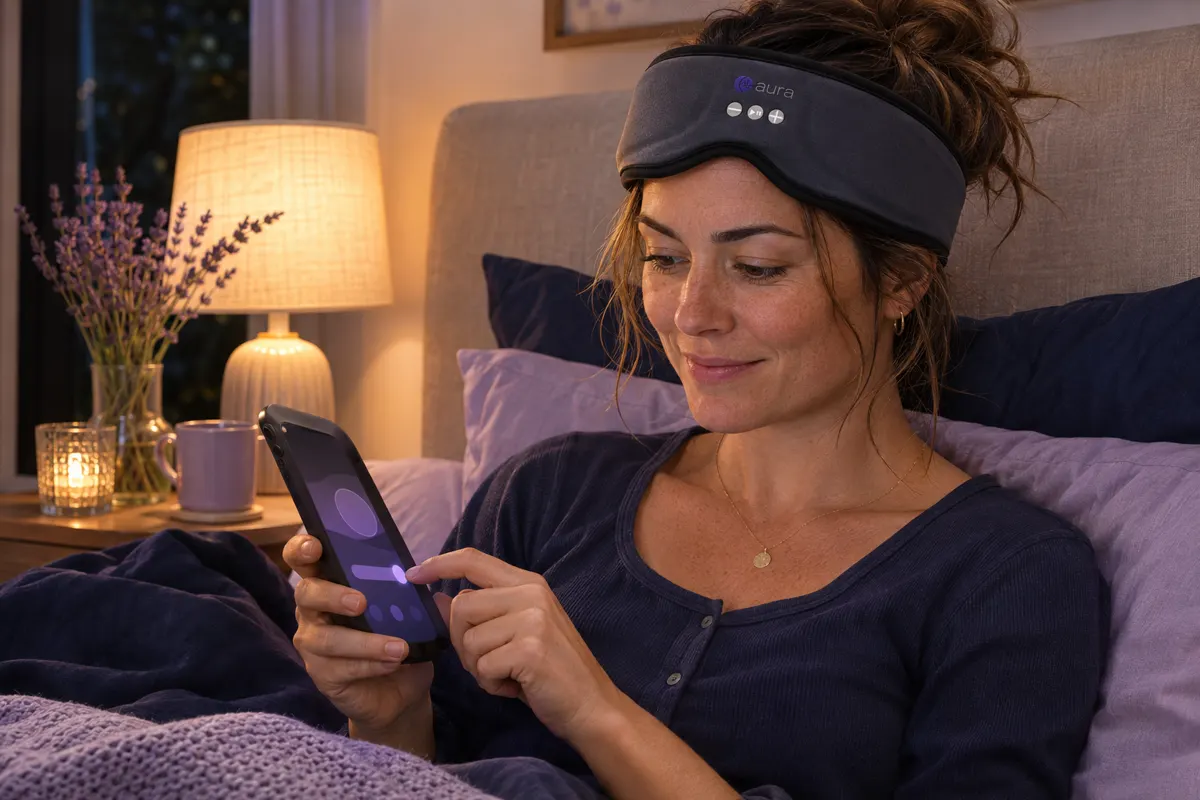
Look at the formula again: the one part you control every night is the time it takes to fall asleep, and whether anything wakes you before the alarm. That is exactly what the AURA Bluetooth Sleep Mask is built for. Complete darkness blocks the light that keeps you alert, and the speakers in the band play rain, brown noise or a calm podcast that covers sudden sounds, then fade out on their own with the auto-shutoff. A dark, quiet start makes it far easier to keep your real "time to fall asleep" close to the 15 minutes in the chart.
Want to check whether the new bedtime is working? Our guide on how to track your sleep at home gives you a copyable sleep diary and shows how to work out your sleep efficiency.
Our recommendation: the AURA Bluetooth Sleep Mask
If you have done the math and now want to actually hit that bedtime and sleep through to the alarm, the AURA Bluetooth Sleep Mask is the option we recommend. It was designed exactly to make dark, quiet, easy-to-start nights the default, at home or away.
- Complete darkness: a 3D contoured blackout shell that leaves your eyelids free, about 24 grams.
- Private sound right over your ears: ultra-thin speakers inside the band play rain, brown noise or a calm podcast from your phone, side-sleeper friendly and quiet for your partner.
- No phone in bed: its 1 to 2 hour auto-shutoff lets the audio fade out on its own.
- Built for nightly use: Bluetooth 5.4, up to 10 hours per charge, and the electronics slide out so the fabric can be hand-washed.
- Risk-free: a 90-day money-back guarantee plus a 1-year warranty.
It is rated 4.8/5 across more than 17,000 verified customer reviews on the official store. With promo code SLEEP26 (50% off), a single mask is $59.99, a 2-pack is $53.99 per mask and a 3-pack is $47.99 per mask. Compare the packs on the AURA overview page, or read our full AURA review.
Frequently asked questions
How do I calculate what time to go to bed?
Start from your wake-up time and subtract whole 90-minute sleep cycles plus about 15 minutes to fall asleep. For 5 cycles (7.5 hours of sleep) with a 6:30 a.m. alarm, that means lights out at about 10:45 p.m.; for 6 cycles (9 hours), about 9:15 p.m.
How long is one sleep cycle?
About 90 minutes on average, but individual cycles often range from roughly 70 to 120 minutes and change across the night, with longer REM periods toward morning. That is why any sleep cycle calculator is an estimate.
How many sleep cycles do I need?
Most adults do well with 5 cycles (about 7.5 hours) or 6 cycles (about 9 hours). The CDC recommends at least 7 hours of sleep a night for adults, so 4 cycles (6 hours) is not enough on a regular basis.
Is it better to sleep 6 hours or 7.5 hours?
7.5 hours. Six hours may feel easier to wake from if it ends a cycle, but it falls below the 7-hour minimum the CDC recommends for adults, and the shortfall adds up over a week.
How do I work out how much sleep I actually got?
Subtract your bedtime from your wake-up time, then subtract the time it took to fall asleep and any time you were awake during the night. Being in bed for 7 hours often means 6 to 6.5 hours of real sleep.
Can a sleep mask help me fall asleep faster?
A dark, quiet environment makes falling asleep easier for most people. The AURA Bluetooth Sleep Mask combines a blackout shell with built-in speakers for soothing sound and an auto-shutoff, which helps keep the falling-asleep part of the math short. It is not a treatment for insomnia or other sleep disorders.