"How to track sleep" is one of the most common sleep questions people type into Google, usually right after a few bad nights. The problem is that most of us measure sleep badly: we judge it by how we feel at 7 a.m., or trust a watch's "sleep score" without knowing what it measures. This guide shows you the right technique: what to log, how to log it, how to turn it into two useful numbers and the mistakes that make home tracking misleading.
Quick answer
The most reliable way to track sleep at home is a simple sleep diary filled in within an hour of waking: the time you got into bed, roughly when you fell asleep, how many times and how long you woke up, your final wake time and when you got out of bed. From those entries you can work out total sleep time and sleep efficiency (time asleep ÷ time in bed). A smartwatch or ring is useful for spotting trends, but it is better at telling sleep from wake than at measuring sleep stages. Track for at least 2 weeks before drawing conclusions. The CDC recommends at least 7 hours a night for adults.
Why measuring sleep at home goes wrong
Two things trip people up. First, memory: after a rough night, a 20-minute wake-up feels like two hours, and after a good one we forget the 3 a.m. bathroom trip. Second, gadgets: a tracker gives you a precise-looking number, so it feels true even when it is an estimate. The fix is a fixed routine: the same questions, answered the same way, every morning.
Step by step: how to keep a sleep diary
- Fill it in within an hour of waking. Not at night (it can keep you awake) and not at lunch (you will have forgotten).
- Log 7 simple items: time into bed, time you tried to sleep, about how long it took to fall asleep, number of wake-ups, total minutes awake during the night, final wake time and time out of bed.
- Estimate, do not clock-watch. Checking the clock at night makes sleep worse. A rough guess ("about 20 minutes") is fine.
- Add 3 context notes: caffeine after noon (yes/no), alcohol in the evening, and anything unusual (noise, light, stress, travel).
- Rate how rested you feel from 1 to 5. This is the number that matters most in daily life.
- Keep it going for 14 nights, weekends included, because weekends are where schedules drift.
A sleep diary template you can copy
| Night | Into bed | Fell asleep after | Wake-ups / minutes awake | Final wake | Out of bed | Rested (1–5) | Notes |
|---|---|---|---|---|---|---|---|
| Example: Mon | 10:45 p.m. | 20 min | 2 / 25 min | 6:30 a.m. | 6:45 a.m. | 3 | Coffee at 3 p.m.; neighbor's TV |
| Example: Tue | 10:30 p.m. | 10 min | 1 / 5 min | 6:30 a.m. | 6:40 a.m. | 4 | No caffeine after noon; sleep mask |
| Night __ | __:__ | __ min | __ / __ min | __:__ | __:__ | __ | __ |
Turn the diary into 2 useful numbers
1. Total sleep time = time from falling asleep to final wake − minutes awake during the night.
2. Sleep efficiency = total sleep time ÷ time in bed × 100.
Worked example (Monday above): in bed 10:45 p.m. to 6:45 a.m. = 480 minutes. Asleep from about 11:05 p.m. to 6:30 a.m. = 445 minutes, minus 25 minutes awake = 420 minutes (7 hours) of sleep. Efficiency = 420 ÷ 480 × 100 = 87.5%.
Look at your 14-night average, not single nights. If total sleep sits below 7 hours, or your efficiency is much lower on some nights than others, the notes column usually tells you why: a late coffee, a noisy street, a bright room.
Sleep diary vs. smartwatch or ring: how far to trust each
| Sleep diary | Watch, ring or app | |
|---|---|---|
| Cost | Free | From an app to a few hundred dollars |
| Good at | Bedtimes, how rested you feel, the reasons behind bad nights | Trends in sleep and wake times over weeks |
| Weak at | Exact minutes awake | Sleep stages (deep, REM) and lying still while awake |
| Best use | Your main record | A second opinion on trends |
The American Academy of Sleep Medicine notes in its position statement on consumer sleep technology that these devices can help people engage with their sleep, but they are not a substitute for a medical evaluation. Many trackers count quiet, still time in bed as sleep, so they can make your nights look better than they were. Use both: the diary as your record, the device for trends.
The most common tracking mistakes
| Mistake | Why it skews your numbers | Do this instead |
|---|---|---|
| Watching the clock at night | Raises alertness and makes it harder to fall back asleep | Turn the clock away; estimate in the morning |
| Logging at bedtime or hours later | Memory fills the gaps with guesses | Within an hour of waking |
| Skipping weekends | Hides social jet lag and sleep-ins | Log all 7 days |
| Judging by 1 or 2 nights | Any night can be an outlier | 14-night average |
| Obsessing over a sleep score | Worry about the score can itself disturb sleep | Check trends weekly, not every morning |
| Changing 5 things at once | You cannot tell what helped | Change one thing, track 2 weeks |
If weekends are your problem, our social jet lag weekend plan helps. To pick a bedtime that fits whole sleep cycles, use our sleep cycle calculator.
How often and how long to track
- Baseline: 14 nights in a row, before you change anything.
- After one change (a new bedtime, darker room, sound masking): another 14 nights, then compare the averages.
- Maintenance: one week a month is enough to make sure things stay on track.
Not sure which change to test first? Our 7-question sleep hygiene self-check points you to your weakest habit.
What to do with the results
Your notes column usually points to one of three culprits: light (a streetlight, a phone, an early sunrise), noise (a partner, a neighbor, traffic) or a racing mind. For light, see sleep mask vs. blackout curtains. For noise, see white, pink or brown noise. For a busy mind, try 9 ways to quiet your thoughts at night. Light and noise are also where a Bluetooth sleep mask does its best work, and your diary is the perfect way to see how much it changes your nights.
Talk to a doctor if your diary shows trouble falling or staying asleep on most nights for weeks, if you snore loudly or someone notices pauses in your breathing, or if you feel very sleepy in the daytime despite enough time in bed. Bring your diary: doctors use the same kind of log.
Our recommendation: the AURA Bluetooth Sleep Mask
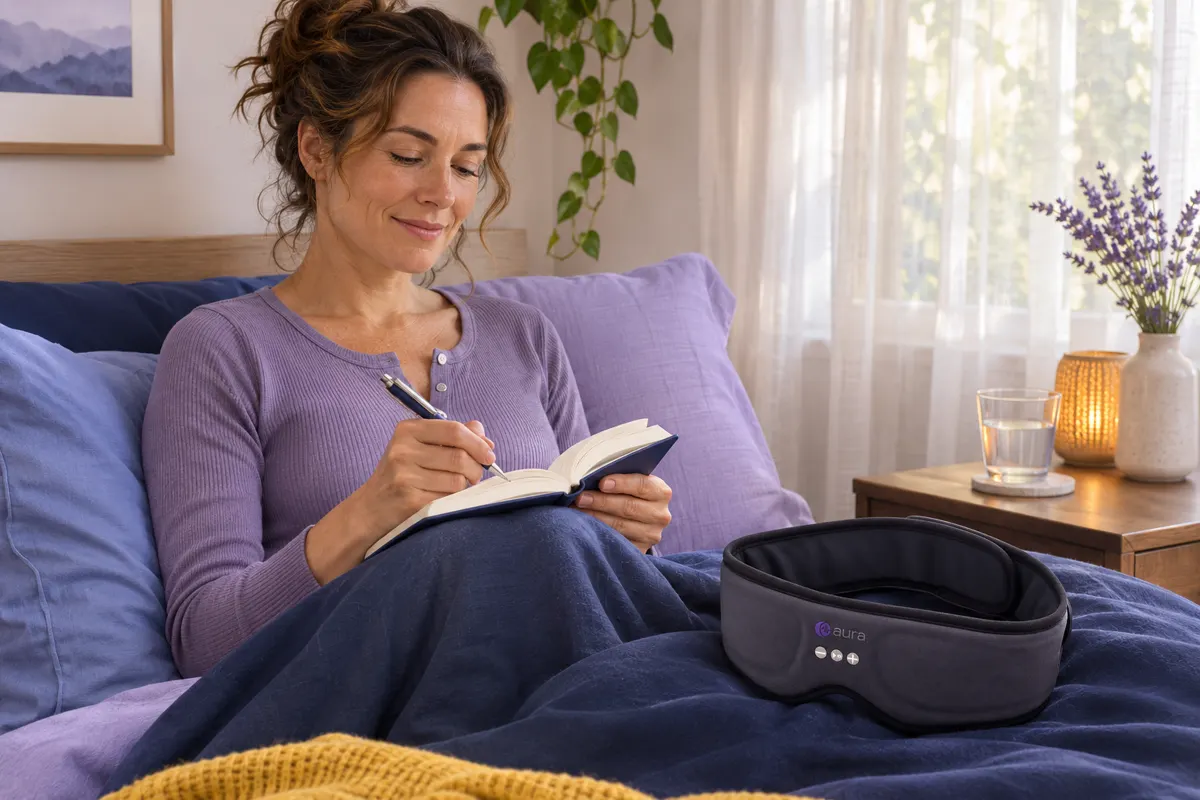
Once your diary shows that light or noise is costing you sleep, the AURA Bluetooth Sleep Mask is the option we recommend. It was designed exactly for this: a dark, quiet, easy-to-start night, and it is simple to test with your diary, because it is one change you can track for two weeks.
- Complete darkness: a 3D contoured blackout shell that leaves your eyelids free, about 24 grams.
- Private sound right over your ears: ultra-thin speakers inside the band play rain, brown noise or a calm podcast from your phone, side-sleeper friendly and quiet for your partner.
- No phone in bed: its 1 to 2 hour auto-shutoff lets the audio fade out on its own, so you are not tempted to check the time.
- Built for nightly use: Bluetooth 5.4, up to 10 hours per charge, and the electronics slide out so the fabric can be hand-washed.
- Risk-free: a 90-day money-back guarantee plus a 1-year warranty, plenty of time for a full diary test.
It is rated 4.8/5 across more than 17,000 verified customer reviews on the official store. With promo code SLEEP26 (50% off), a single mask is $59.99, a 2-pack is $53.99 per mask and a 3-pack is $47.99 per mask. Compare the packs on the AURA overview page, or read our full AURA review.
Frequently asked questions
What is the best way to track sleep at home?
A simple sleep diary filled in within an hour of waking is the most reliable home method: log the time into bed, how long it took to fall asleep, wake-ups, final wake time, time out of bed and how rested you feel. A watch or ring can add trend data, but the diary should be your main record.
How accurate are sleep trackers?
Consumer sleep trackers are reasonably good at telling sleep from wake over many nights, but less reliable for sleep stages such as deep and REM sleep, and they can count quiet time awake in bed as sleep. The American Academy of Sleep Medicine says they are not a substitute for a medical evaluation.
How do I calculate sleep efficiency?
Divide your total sleep time by the time you spent in bed and multiply by 100. For example, 420 minutes asleep during 480 minutes in bed gives a sleep efficiency of 87.5%.
How long should I keep a sleep diary?
Keep it for at least 14 nights in a row, including weekends, to get a reliable baseline. After changing one habit, track another 14 nights and compare the averages.
How many hours of sleep do adults need?
The CDC recommends at least 7 hours of sleep per night for adults aged 18 to 60, and 7 to 9 hours for adults 61 to 64.
Can a sleep mask improve my diary numbers?
If your notes show that light or noise wakes you or keeps you from falling asleep, a sleep mask that blocks light and plays soft sound can help. Test it the right way: change only that one thing and compare two weeks of diary entries.