A car door slams at 2 a.m., the neighbor's dog barks, your partner starts to snore — and you are wide awake. Yet thousands of people fall asleep every night to a steady “shhh” and sleep straight through those same sounds. That is not magic, and it is not just habit. It is a simple trick of how your brain listens at night. Here is how sound masking really works, what actually separates white, pink and brown noise, and how to pick the right one for your bedroom.
Quick answer
Steady background noise helps you sleep by making sudden sounds stand out less. Your brain keeps listening at night, and what wakes you is not loudness but change: a spike against silence. A constant sound fills that silence, so the slam, the bark or the snore becomes a smaller jump. White noise spreads its energy evenly and sounds like a bright hiss; pink noise leans toward lower tones and sounds like steady rain; brown noise is deeper still, like a distant waterfall. None is “best” for everyone: choose the one you find calm, keep it quiet and steady, and use a timer. The easiest way to do all of that without disturbing a partner is the AURA Bluetooth Sleep Mask, which plays your sound privately over flat speakers while blacking out light.
Why sudden sounds wake you (and steady ones don't)
Your ears never really switch off. During sleep, the brain keeps a low-level watch on the sounds around you and decides, again and again, whether something deserves to wake you. It is very good at ignoring what stays the same: the hum of a fridge, an air conditioner, rain on the roof. What it reacts to is contrast — a sound that suddenly rises above the background.
That is why a quiet bedroom can actually be a light sleeper's worst enemy. When the background is near silence, even a soft creak is a big jump. Lighter stages of sleep, especially in the second half of the night and in unfamiliar places, make that watchfulness even sharper; we explain the “night watch” effect in why you can't sleep in a new place.
How sound masking actually works
Think of a single candle. In a pitch-dark room, it catches your eye immediately. Switch on the ceiling light, and the same candle barely registers. Sound masking does the same thing with noise: a steady, gentle sound raises the “floor” of the room, so the difference between that floor and a sudden noise shrinks.
- It does not erase the noise. The traffic is still there; it simply stands out less, so it is less likely to pull you out of sleep.
- It works best when it is steady. A constant, even sound becomes predictable, and the brain learns to tune it out within minutes.
- It covers the right frequencies. A masking sound works best when its energy overlaps with the sounds that bother you, which is exactly where the noise “colors” differ.
- It gives a busy mind something neutral to rest on. For many people, a soft, meaningless sound also crowds out the thought loops of a racing mind; see 9 ways to quiet a racing mind at night.
White vs. pink vs. brown noise: what's the difference?
The “color” of a noise describes how its energy is spread from low to high pitches. Here is the plain-English version:
| Noise | How the energy is spread | What it sounds like | Often chosen for |
|---|---|---|---|
| White noise | Equal across all frequencies, so high tones are very present | A bright hiss: TV static, a fan on high, an air vent | Covering voices, TV through the wall and sharp sudden sounds |
| Pink noise | Leans toward lower frequencies; each step up in pitch gets a little softer | Steady rain, rustling leaves, gentle surf | A balanced, softer all-rounder that many people find easier to listen to all night |
| Brown noise | Even more weight in the low frequencies, high tones very soft | A deep rumble: a distant waterfall, strong wind, a plane cabin | Low sounds such as traffic, snoring, a rumbling building, and people who find white noise too harsh |
Real-world sounds like rain, ocean or a fan usually fall somewhere between these colors, which is why many people simply pick the nature sound they like best.
Which one should you choose?
- Street noise, trucks or a noisy building: start with brown or pink noise. Their low-frequency weight overlaps with rumbling sounds.
- A snoring partner: pink or brown noise usually blends better with the low, rhythmic sound of snoring; our guide to sleeping next to a snoring partner covers the rest of the plan.
- Voices, a TV next door or a busy household: white or pink noise covers the mid and high tones of speech well.
- A busy mind with no outside noise: choose the softest sound you enjoy, often pink noise or rain, at a very low volume.
- Travel and hotels: bring the same sound you use at home. Familiar sound is one of the fastest ways to make an unfamiliar room feel safe.
The honest rule: the best color is the one you find calm enough to ignore. Try each for three or four nights before deciding; your brain needs a few nights to get used to any new sound.
What the research says (honestly)
Sound masking is widely used, and many people find it genuinely helpful, especially in noisy environments. The scientific picture, though, is still developing: studies are mostly small, results are mixed, and no color has been proven clearly better than the others for everyone. Researchers have shown particular interest in pink noise and deep sleep, but that work is early. The practical takeaway is simple: if outside noise or a light-sleeping brain is what keeps you up, a steady masking sound is a low-risk, easy thing to try; if your sleep problem has another cause, noise alone will not fix it.
How to use noise for sleep the right way
- Keep it quiet. Set the volume just loud enough to blur background sounds, about the level of a soft conversation or lower. Louder is not better and is harder on your ears over a whole night.
- Keep it steady. Avoid tracks with sudden changes, birdsong bursts or loud loops; the point is a predictable sound.
- Use a timer when you can. Many people only need the sound while falling asleep and during the lighter first cycles. A 1 to 2 hour timer gives you the masking without all-night exposure.
- Keep the sound close to you. A speaker across the room has to be louder to reach you, and it fills the room for your partner too. Sound played right by your ears can stay at a much lower volume.
- Pair it with darkness. Light and sound wake people for the same reason: change. Blocking both covers the two biggest triggers at once; see sleep mask vs. blackout curtains.
That combination of quiet, steady, close and dark is exactly what an audio sleep mask such as the AURA was designed to deliver in one piece.
When to talk to a doctor
Noise masking helps with noise. Talk to a doctor if you have trouble sleeping three or more nights a week for several weeks, if you snore loudly, gasp or stop breathing at night (possible sleep apnea), if you feel very sleepy during the day despite enough time in bed, or if ringing in the ears or hearing changes are what keep you awake. Those deserve a proper check, not just a sound machine.
Our recommendation: the AURA Bluetooth Sleep Mask
Sound masking works best when the sound is quiet, steady, close to your ears and paired with real darkness. The tool we recommend for exactly that is the AURA Bluetooth Sleep Mask. It turns white, pink or brown noise, rain or any audio you like into a private sound layer right over your ears, and blacks out the light at the same time.
- Your noise color, privately. Ultra-thin speakers slide inside the padding over your ears and stream any white, pink or brown noise track or app from your phone, at a low volume your partner will not hear.
- Total blackout without eye pressure. 3D contoured eye cups seal out street lamps, early sunrise and blinking LEDs while leaving room to blink.
- Comfortable for side sleepers. Flat speakers and soft, breathable fabric, so lying on your side presses foam, not plastic, against your head.
- Built for the right habits. Bluetooth 5.4, up to 10 hours of battery, a 1 or 2 hour auto-shutoff timer, about 24 grams, and the electronics pop out so the mask is washable.
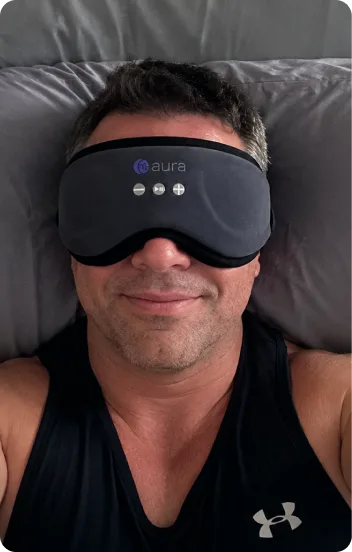
It is rated 4.8/5 across more than 17,000 verified customer reviews on the official store. With promo code SLEEP26 (50% off), a single mask is $59.99, a 2-pack is $53.99 per mask and a 3-pack is $47.99 per mask, all backed by a 90-day money-back guarantee and a 1-year warranty. One small note: it masks noise with steady audio rather than actively canceling it, which is exactly what keeps it light and comfortable enough to sleep in. For the packs side by side, see the AURA overview page.
Frequently asked questions
Is white, pink or brown noise best for sleep?
There is no single winner for everyone. White noise is bright and covers voices and sharp sounds; pink noise is softer and sounds like steady rain; brown noise is deeper and blends well with low sounds such as traffic or snoring. The best choice is the one you find calm enough to ignore.
How does white noise help you sleep?
It raises the steady background level of the room, so sudden sounds create a smaller jump and are less likely to wake you. The brain reacts mostly to changes in sound, and a constant noise reduces those changes.
Is it bad to sleep with noise on all night?
For most adults a low, steady sound is fine, but quieter is better and you may not need it all night. Keep the volume low, about the level of a soft conversation or below, and use a 1 to 2 hour timer if you only need help falling asleep.
What does brown noise sound like?
Brown noise is a deep, low rumble with very little high-pitched hiss, similar to a distant waterfall, strong wind or the inside of a plane cabin. Many people who find white noise too harsh prefer it.
Can I use white noise without disturbing my partner?
Yes, by playing it close to your ears instead of through a room speaker. An audio sleep mask such as the AURA Bluetooth Sleep Mask streams the sound through flat speakers over your ears at a low volume, so your partner hears little or nothing.