"Do women need more sleep than men?" is one of those questions that pops up every time a couple compares their nights. The short version: the official target is the same, but women and men tend to lose sleep for very different reasons. Knowing which sleep thieves are most likely in your case is what changes the fix.
Quick answer
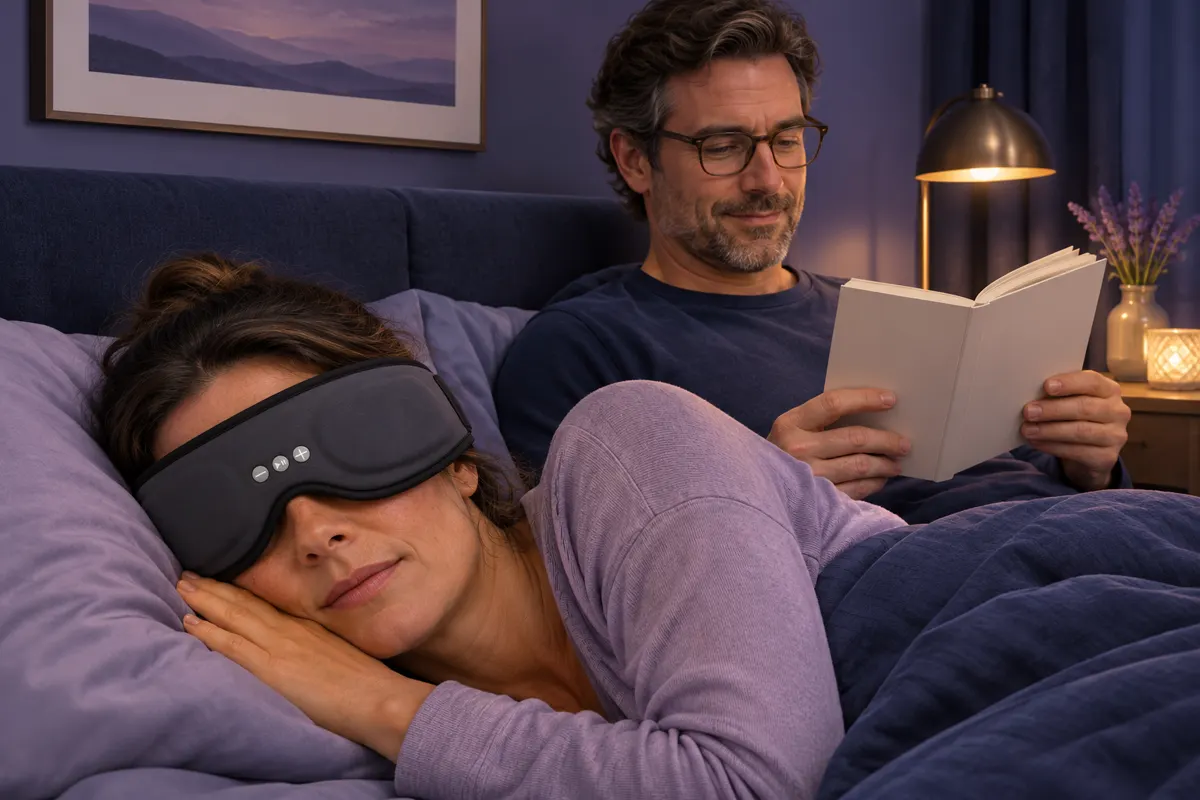
Official guidance does not say women need more sleep: the CDC recommends at least 7 hours a night for every adult from 18 to 60, women and men alike. What differs is how sleep goes wrong. Women are more likely to have insomnia and sleep that shifts with the menstrual cycle, pregnancy and menopause. Men are more likely to snore and have sleep apnea, which often wakes their partner too. Studies even suggest women sleep a few minutes longer on average but rate their sleep quality lower. The fix depends on which thief is stealing your nights, and for light and noise, a Bluetooth sleep mask helps both.
What is the same for women and men
The baseline does not change with sex. The CDC recommends 7 or more hours of sleep a night for adults 18 to 60, and 7 to 9 hours for adults 61 to 64. The basics that protect sleep are the same too: a steady wake time, a dark, quiet and cool bedroom, less caffeine after lunch, less alcohol in the evening and a wind-down without screens. If you want to check yours, our 7-question sleep hygiene self-check takes two minutes.
So where does the idea that women "need more sleep" come from? Mostly from commentary by sleep researchers suggesting women may need a little more recovery time, and from surveys showing women sleep a few minutes longer on average. It is an interesting idea, but it is not an official recommendation. A better question is: what is stealing your sleep?
Difference 1: insomnia is more common in women
Trouble falling or staying asleep is reported more often by women. The NHLBI lists being female among the factors linked with insomnia, and reviews cited by the Sleep Foundation put the gap at roughly 40 to 60 percent. Worry, caregiving loads and hormonal shifts all play a part.
What it changes: the priority is calming the mind and the room at bedtime: a fixed wind-down, no clock-watching, and steady sound to drown out the thoughts. Our guide to a racing mind at night has nine practical ways in.
Difference 2: hormones, the cycle, pregnancy and menopause (women)
Sleep often gets lighter or more broken in the days before a period, during pregnancy (discomfort, bathroom trips, heartburn) and around menopause, when hot flashes and night sweats can wake women repeatedly. The Sleep Foundation notes that insomnia becomes more common as women move through menopause.
What it changes: a cooler bedroom, breathable bedding and layers you can throw off; a darker room for early-morning light; and a plan for getting back to sleep after a wake-up (dim light, calm audio, no phone). Talk to your doctor if hot flashes or pregnancy discomfort are wrecking your nights; there are options.
Difference 3: snoring and sleep apnea are more common in men
Obstructive sleep apnea, where breathing repeatedly stops and starts during sleep, is diagnosed more often in men, according to the NHLBI; the risk in women rises after menopause, and it is thought to be underdiagnosed in women. Men also snore more often, which affects two people: the snorer and the partner.
What it changes: loud snoring with pauses, gasping or heavy daytime sleepiness deserves a medical check, because sleep apnea is treatable and a sleep mask or earplugs do not fix it. For the partner, masking the sound is the practical part; see how to sleep with a snoring partner.
Difference 4: sleep quality vs. sleep length
Surveys repeatedly find a curious pattern: women sleep about as long as men, sometimes a few minutes longer, yet report feeling less rested. Lighter, more broken sleep, more night-time wake-ups and the partner's snoring are the usual suspects.
What it changes: judge your nights by quality, not just hours. Two weeks of a simple sleep diary shows whether you are short on time in bed or losing sleep to wake-ups.
Women vs. men at a glance
| What changes | Women | Men | Source |
|---|---|---|---|
| Recommended sleep | 7+ hours (18–60) | 7+ hours (18–60) | CDC |
| Insomnia | More common | Less common | NHLBI, Sleep Foundation |
| Hormone-related changes | Cycle, pregnancy, menopause (hot flashes) | Gradual changes with age | Sleep Foundation |
| Sleep apnea and snoring | Less often diagnosed, rises after menopause | More common | NHLBI |
| Typical complaint | Light, broken sleep; trouble falling back asleep | Snoring, daytime sleepiness | Sleep Foundation |
| What helps both | Steady wake time, dark and quiet room, calm wind-down | CDC | |
What to do in your case
- If you lie awake thinking: a fixed wind-down, phone out of reach, and steady calm sound right at your ears.
- If hormones or hot flashes wake you: keep the room cool, wear breathable fabric and use a lightweight mask that does not trap heat on your face.
- If your partner snores: mask the sound at your ears instead of turning up a speaker for the whole room, and encourage a check-up if the snoring comes with pauses or gasps.
- If you snore: see a doctor about sleep apnea, then work on alcohol, sleep position and weight.
- If early light wakes you: full blackout around your eyes beats waking at sunrise; compare options in sleep mask vs. blackout curtains.
Notice how often two of the answers are the same for both: darkness and sound. That is where the AURA mask comes in.
Our recommendation: the AURA Bluetooth Sleep Mask
Whether your sleep thief is a racing mind, early light, hot-flash wake-ups or a partner who snores, the AURA Bluetooth Sleep Mask is the option we recommend. It covers the two things women and men share: the need for a dark room and steady, private sound, in one light piece you wear in bed.
- Complete darkness: a 3D contoured blackout shell that leaves your eyelids free, about 24 grams.
- Private sound right over your ears: ultra-thin speakers inside the band play rain, brown noise or a calm podcast from your phone, side-sleeper friendly and quiet for your partner.
- Breathable and cool: a cooling fabric that does not trap heat, helpful on warm nights.
- No phone in bed: its 1 to 2 hour auto-shutoff lets the audio fade out on its own.
- Built for nightly use: Bluetooth 5.4, up to 10 hours per charge, and the electronics slide out so the fabric can be hand-washed.
- Risk-free: a 90-day money-back guarantee plus a 1-year warranty.
It is rated 4.8/5 across more than 17,000 verified customer reviews on the official store. With promo code SLEEP26 (50% off), a single mask is $59.99, a 2-pack, perfect for couples, is $53.99 per mask and a 3-pack is $47.99 per mask. Compare the packs on the AURA overview page, or read our full AURA review.
A sleep mask supports better sleep habits; it does not treat insomnia or sleep apnea. If you have ongoing sleep problems, talk to your doctor.
Frequently asked questions
Do women need more sleep than men?
Official guidance is the same for both: the CDC recommends at least 7 hours a night for adults 18 to 60. Some researchers suggest women may need slightly more recovery time, and surveys show women sleep a few minutes longer on average, but that is not an official recommendation. What differs more is how sleep goes wrong.
Why do women have more trouble sleeping than men?
Women are more likely to have insomnia, and sleep can be disrupted by the menstrual cycle, pregnancy and menopause, when hot flashes and night sweats often wake women up. Stress and caregiving loads also play a part.
Is sleep apnea more common in men?
Yes. The NHLBI notes that obstructive sleep apnea is more common in men, although the risk in women rises after menopause and it is thought to be underdiagnosed in women. Loud snoring with pauses or gasping deserves a medical check.
Why do women feel less rested even when they sleep as long?
Surveys suggest women's sleep is more often light or broken, with more wake-ups during the night, sometimes because of a partner's snoring. Total hours can look fine while quality is poor, which is why a sleep diary helps.
Can a sleep mask help with menopause sleep problems?
A sleep mask cannot treat hot flashes, but a light, breathable mask with built-in audio can make it easier to fall back asleep after a wake-up by keeping the room dark and playing calm sound. Talk to your doctor about hot flashes themselves.
Is the AURA mask good for couples?
Yes. The speakers sit right over your ears, so one partner can listen to rain or a podcast without disturbing the other, and it helps the light sleeper drown out snoring. The 2-pack is $53.99 per mask with code SLEEP26.